What if you could build a portfolio that historically delivered better returns than a broad market benchmark while taking significantly less risk? It sounds too good to be true, yet this is exactly why diversification is often called the only free lunch in investing. In-fact goal of our platform is to let a regular retail investor build well tested diversified portfolios.
Why Diversification Matters
Diversification, or asset allocation, is the practice of combining different asset classes such as equities, bonds, and gold to balance risk and return. Instead of relying on a single source of performance, investors combine assets that behave differently under varying market conditions.
The secret lies in correlation. When assets do not move in lockstep, the ups and downs of one investment can be partially offset by another. The result is often a smoother investment journey without necessarily sacrificing returns.
A Surprising Experiment
Rather than diving into complex concepts like expected returns, covariance matrices, and portfolio optimization, let's look at a simple example.
The Nifty 500 serves as a benchmark for many flexi-cap funds. Now imagine constructing a portfolio that contains only 50% equity, yet has historically outperformed the Nifty 500 across long time horizons while taking substantially less risk.
Sounds like magic? It is simply the power of diversification at work.
Building the Portfolio
For this exercise, we combine:
- 50% Nifty Midcap 150 Index - chosen because it has historically delivered strong long-term returns.
- 50% 5-Year Government Security Index - selected for its relatively attractive returns among debt instruments and its low correlation with mid-cap equities.
That's it. Experiment link
Despite holding only half of its allocation in equities, this portfolio has historically:
- Outperformed the Nifty 500 more than 50% of the time across 1-year, 3-year, 5-year, 7-year, and 10-year rolling periods.
- Delivered lower volatility.
- Exhibited lower beta.
- Experienced lower standard deviation.
- Shown smaller downside deviations during market declines.
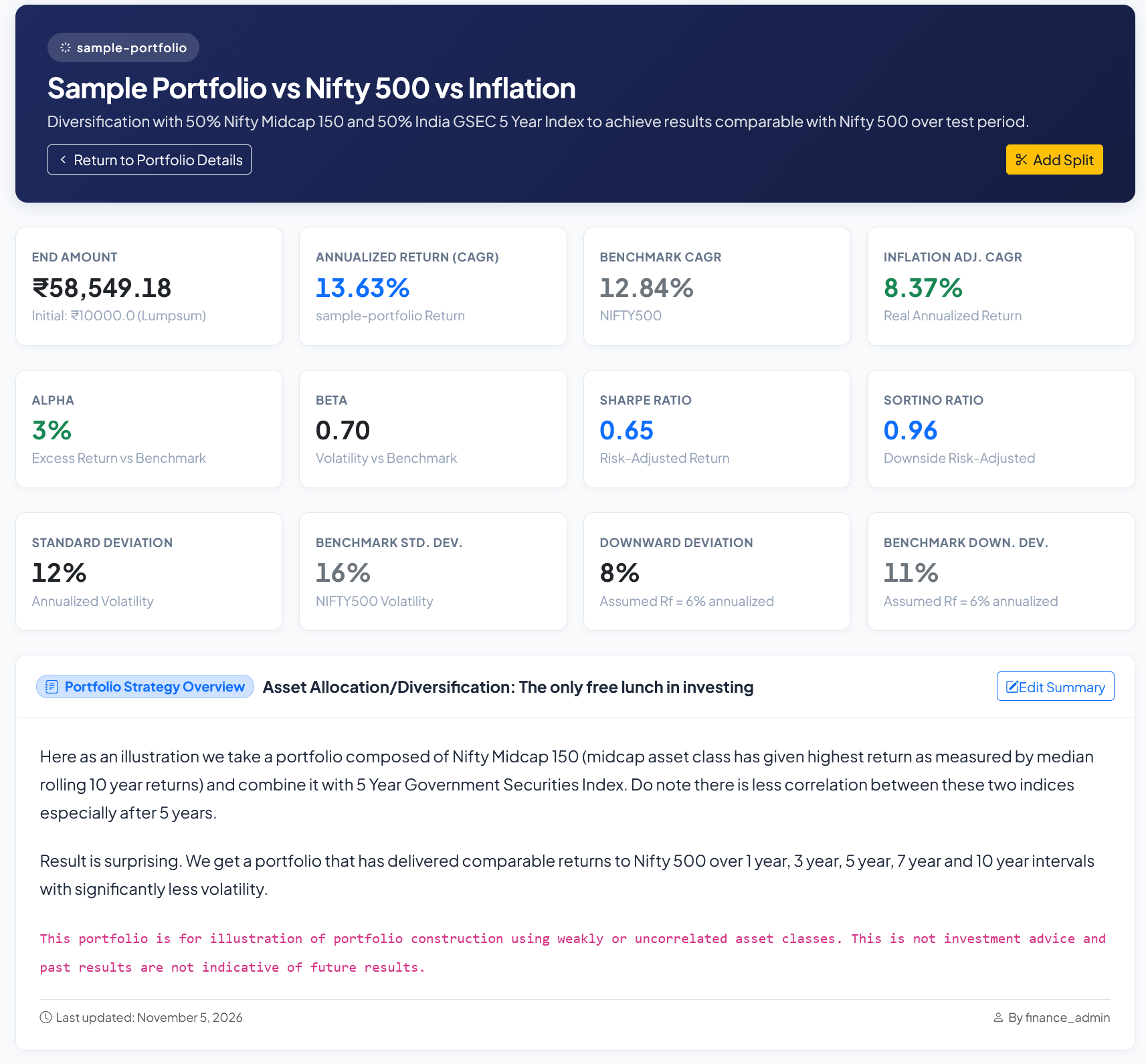
In other words, investors received a smoother ride while still participating in attractive long-term growth.
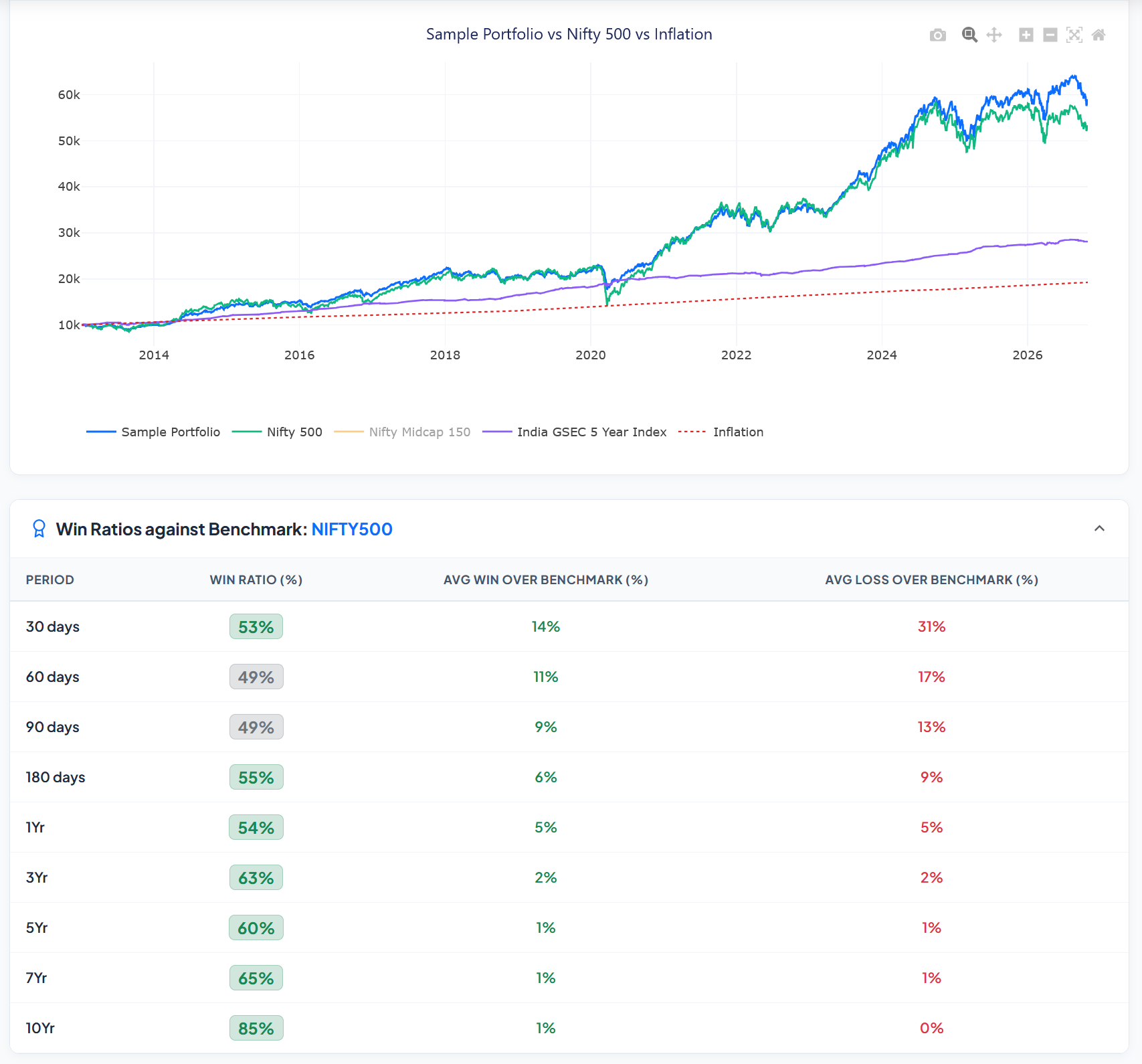
The Rebalancing Bonus
Diversification becomes even more powerful when combined with periodic rebalancing.
As markets move, the weight of each asset class drifts away from its target allocation. By rebalancing, investors sell a portion of what's performed well and add to what's underperformed.
As an academic exercise, try rebalancing this portfolio during the market dislocation of April 2020 (for example, around 2020-04-01) and compare the results. The impact may surprise you. Experiment Link
Important Caveats
Before rushing to replicate this portfolio, remember:
- Past performance does not guarantee future results.
- Historical winners do not always remain winners.
- Asset relationships change over time.
- Results depend heavily on the chosen time period.
For example, replacing the Nifty Midcap 150 with the Nifty Smallcap 250 does not necessarily produce better outcomes.
The lesson is not that mid-caps are superior. The lesson is that combining a riskier asset with a relatively stable, less-correlated asset can significantly improve the overall risk-return profile of a portfolio.
What About Gold?
Diversification does not stop with equity and debt.
Gold often behaves differently from both stocks and bonds, making it an interesting portfolio component. The addition of gold may improve diversification benefits during certain market environments, although the impact varies across different time horizons.
The only way to know is to test it.
Try It Yourself
Activity 1: Build Your Own Portfolio
Create portfolios using different combinations of equity and debt funds. Don't focus solely on returns. Compare:
- Volatility
- Drawdowns
- Standard deviation
- Risk-adjusted returns
Activity 2: Add Gold
Replace half of the debt allocation with gold and evaluate performance over:
- 1-year rolling periods
- 3-year rolling periods
- 5-year rolling periods
How does the risk-return profile change?
Activity 3: Hunt for Low Correlation
Can you identify equity indices or funds that have maintained a correlation below 0.5 with the Nifty 500 or Nifty 50 over at least five years?
The search itself is an excellent lesson in diversification.
Key Takeaway
Diversification does not eliminate risk, nor does it guarantee superior returns. What it can do is improve the odds of achieving your investment goals by reducing dependence on any single asset class.
The biggest investing breakthroughs are often not about finding the next winning stock. Sometimes, they come from combining ordinary assets in an intelligent way.
That is why diversification continues to be called the only free lunch in investing.
Disclaimer
This example is provided for educational and illustrative purposes only. We do not know how the portfolio will perform in the future, nor can we guarantee that it will outperform the Nifty 500 or exhibit lower risk going forward. Past performance is not indicative of future results.
In real-world investing, ETFs and index funds may underperform their benchmarks because of factors such as tracking error, expenses, taxes, and implementation costs. The primary objective of this example is to demonstrate how combining assets with lower correlations can help reduce portfolio volatility.
Discussion
0 commentsJoin the Conversation
Sign in to share your thoughts, exchange ideas with the community, and reply to comments.
No comments yet
Be the first to share your perspective on this article!